MISSION STATUS
? what am I looking at
The hydrogen-o-meter measures how much extra radio power sits in the hydrogen window (1420.2–1420.55 MHz) compared with the frequencies either side, counted in σ (“sigma”) — how many times bigger than the random noise wiggle it is. Below 2σ is just noise doing noise things. 5σ is the scientists’ bar: gold light, and the crew runs the detection checklist — the machine only finds candidates; people make detections.
Peak this run remembers the biggest σ seen and when — so a 3 am event is still on the board at breakfast.
WHERE IS THE BEAM POINTING?
? what am I looking at
The horn points straight up and never moves — the Earth does. As it turns, the beam sweeps a strip of sky. This panel converts “straight up, right now” into galactic coordinates: l is the address around the Milky Way’s disc (0° = towards the centre), b is how far above/below the disc we’re aimed.
When b is within ±10° the beam is in the galactic plane — staring into the thick of the hydrogen. That’s when the hydrogen-o-meter has its chance.
LST is star time: the sky’s own clock, which runs 4 minutes fast on ours per day. Real sky signals keep THIS clock — that’s one of our detection tests.
TOTAL POWER THROUGH THE RUN (the first-light instrument)
? what am I looking at
ALL the radio power the horn collects, added up, every 30 seconds. This is the classic radio-astronomy strip chart: when the Sun drifts through the beam it draws a beautiful 90-minute bump on exactly this graph — our week-8 first-light measurement. A hand over the horn mouth nudges it. Day and night breathe in it. Sudden steps are usually electronics, not sky.
HYDROGEN-O-METER THROUGH THE RUN
? what am I looking at
The σ value sampled every 30 seconds since the run began. Flat grass = quiet sky. A slow rise while the beam drifts into the galactic plane is exactly what a real detection looks like — and a sudden spike that ignores the sky is probably someone’s power supply (RFI). Shape over time is evidence.
DRIFT SCAN — POWER vs WHERE WE'RE POINTING
? what am I looking at
Every 30-second sample plotted by the galactic longitude the beam was aimed at when it was taken (the Earth's rotation chooses this for us). Gold dots were taken while in the galactic plane, grey dots off-plane. The signature of a real detection: the gold points sit higher than the grey — more radio power when we stare into the Milky Way's disc than when we stare off it. This is the whole experiment on one graph.
TONIGHT'S SKY SCHEDULE — NEXT 24 HOURS
? what am I looking at
Where the fixed beam will point over the next day as the Earth turns: the line is b (height above the galactic disc). The gold bands are the plane crossings — the windows worth watching, when the hydrogen is in the beam. The orange marks show when the Sun is overhead (daytime — noisier, but 1420 MHz sees through it). “Now” is the dashed line. This is the telescope's timetable — it never changes who it looks at, only when.
AVERAGED SPECTRUM
? what am I looking at
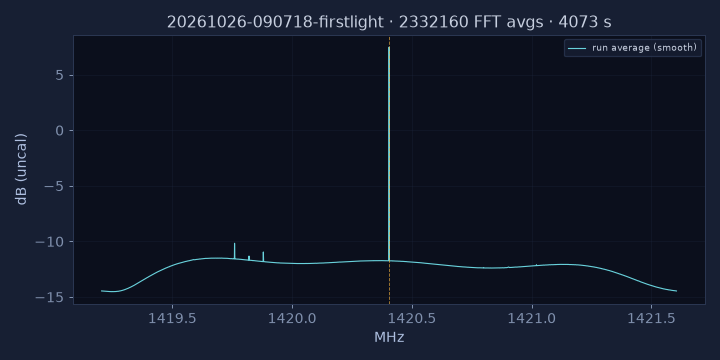
Radio power at each frequency, averaged over the whole run so far. The wiggly line is the noise floor — the combined hiss of our electronics and the warm world. The thin spike dead-centre is the DC spike: the receiver hearing its own heartbeat. It is not space (we proved it: it follows the tuning).
The hydrogen line, when it comes, is a broad soft hump a few hundred kHz wide near 1420.405 MHz — wide because the gas moves at thousands of different speeds, each Doppler-shifting its whisper.
The longer we average, the smoother the grass gets: noise shrinks as 1/√time (the radiometer equation) — patience is our microscope.
WATERFALL — THE NIGHT SO FAR
? what am I looking at
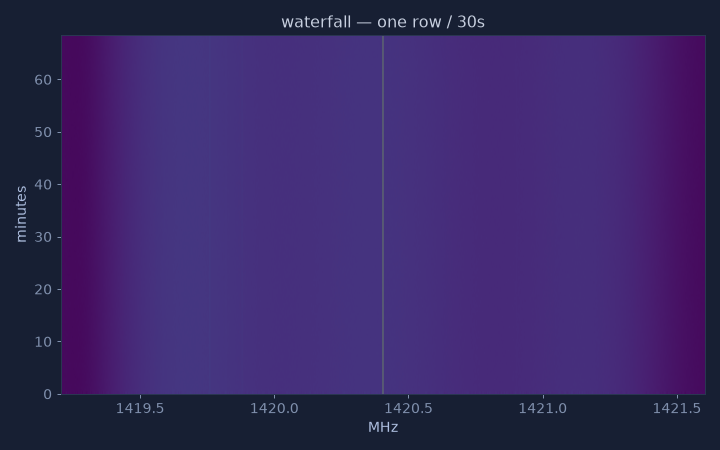
Every 30 seconds the spectrum is painted as one new row: frequency across, time upward, brightness = power. A steady vertical line is something constant (instrument or RFI). A bright patch that drifts and changes as the hours pass is the sky moving through our beam — the galaxy literally scrolling past a telescope that never moved.
THE MACHINE
? what am I looking at
The observatory is a Raspberry Pi at the horn. FFT averages counts how many 4096-point spectra have been stacked — hundreds of thousands per hour. It processes ~2.3 million samples per second, all night, on about 3 watts.
RUN LOG
HOW THIS OBSERVATORY WORKS — the whole story
1 · What we're listening to. Most of the universe is hydrogen — one proton, one electron. Very occasionally (about once per atom per 11 million years) the electron flips its spin and the atom releases a single radio wave at exactly 1420.405 MHz — a wave 21 cm long. One atom is nothing; a galaxy's worth is a steady hum filling the whole sky. That hum carries a fingerprint: gas moving towards or away from us shifts the frequency (the Doppler effect), so the hum's exact pitch tells us how fast parts of the galaxy are moving.
2 · The instrument. A pyramidal horn antenna, hand-cut from foil-faced insulation board, funnels a 66×66 cm patch of incoming wave down to a single 5.3 cm brass wire (one quarter of the wavelength). The wire sits 7.7 cm in front of a metal back wall — placed so the reflected wave arrives back in step and reinforces it. The wiggling voltage goes to an amplifier at the feed, then into a software-defined radio: a USB stick that measures the wave 2.4 million times every second.
3 · A telescope that never moves. The horn points straight up. It doesn't track anything — the Earth is the drive motor. As the planet turns, the beam sweeps a great circle through the sky once every 23 h 56 min (the sky's own day, 4 minutes shorter than ours). Twice a day the beam crosses the plane of the Milky Way, and the hydrogen hum swells. This is called a drift scan, and it's how the first radio astronomers worked.
4 · What the computer does. The Raspberry Pi running this page splits each second of radio into thousands of frequency bins (a Fourier transform) and averages, hour after hour. Random noise averages away as 1/√time while a real signal stays put — so the longer we listen, the fainter the whisper we can hear. The hydrogen-o-meter above is simply asking, every 30 seconds: is there more power in the hydrogen window than in the frequencies beside it?
5 · What we're really hunting. By measuring the hum's Doppler shift at different galactic longitudes, we can work out how fast the galaxy rotates at different radii — the rotation curve. Done carefully, it shows something famous and unsolved: the outer galaxy spins too fast for the matter we can see to hold it together. Either there is unseen mass — dark matter — or gravity itself surprises us. A backyard horn can measure this. That's the whole point.
6 · Who built it. Ewan, Alex and Naoki — three students, Year 6 — cut, bonded, soldered, derived and verified every part of this instrument in an after-school program. Every number in the design (the 66 cm mouth, the 5.3 cm probe, the 1420.405) they calculated themselves before building it. The observatory runs on about 3 watts, costs less than a games console, and does real astrophysics.